
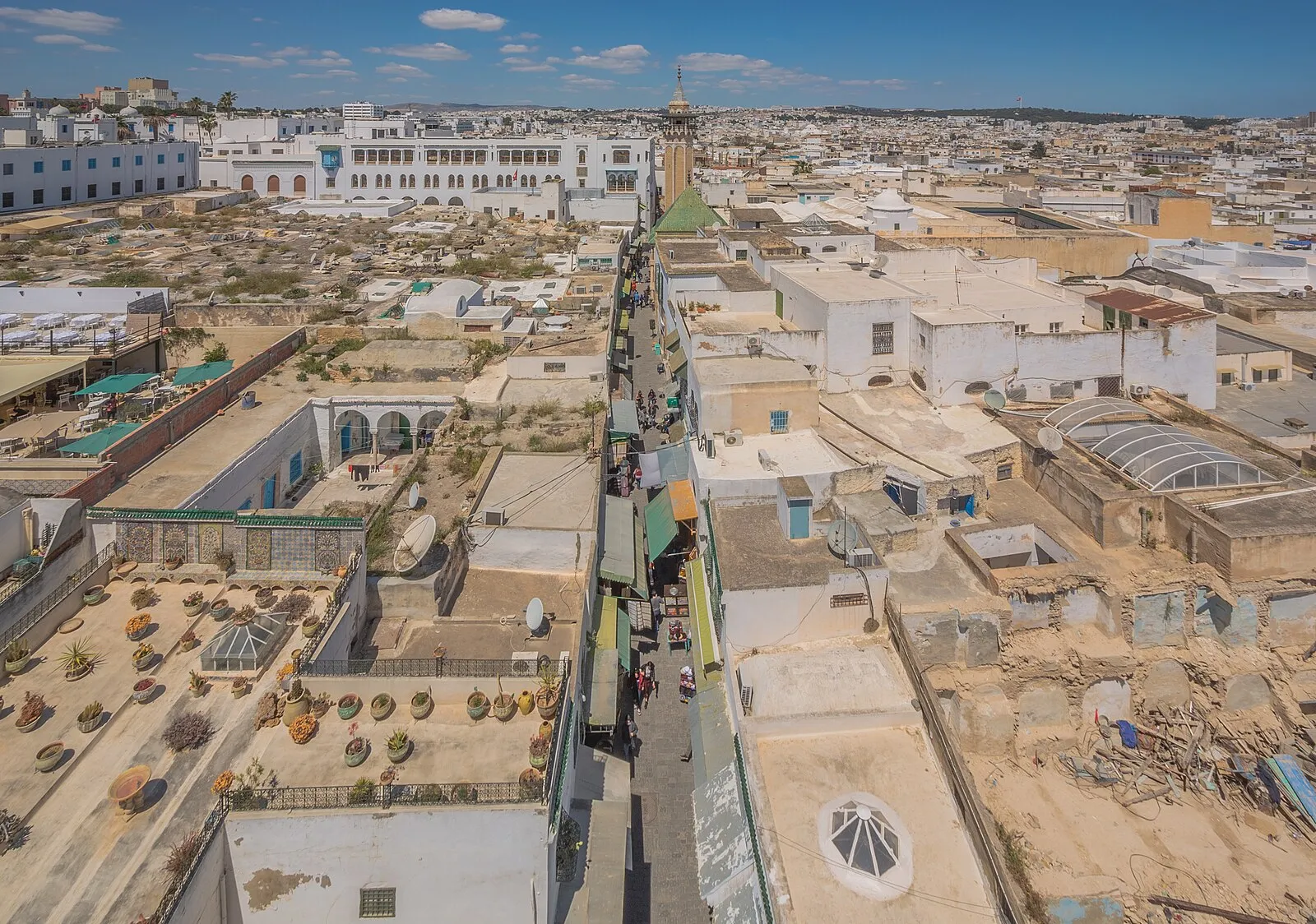
Cost of Living inTunis, Tunisia
Image credit: Karl Friedrich Gsur
Purchasing Power vs. United States
Based on GDP per capita (PPP). Tunisia: $12,775/capita.
How Far Your Money Goes
Prices are 68% lower than the global benchmark (New York City = 100).
Income Category
Happiness
4.4 / 10
#113 globally
GDP per Capita
City Population
Monthly Costs
Rent
Food
Transport
Utilities
Education
Child Education
Public-school quality + expat access, alongside international and private school cost — the two paths a relocating family weighs.
Public schools
Public-schooling rules are set nationally for Tunisia; Tunis-specific enrollment notes are still being verified.
Quality
Mixed public schools
Assessment snapshot: 2022
Expat access
Language-heavy for non-Arabic speakers
hardInstruction
Arabic / French
Language fit is more manageable.
PISA / outcomes
374
Well below OECD avg
PISA 2022 · OECD avg ~480
Why this quality rating
Tunisia has a reasonably structured public school system by North African standards, with Arabic and French as instruction languages. Quality varies significantly by region. International schools in Tunis serve expatriate families.
Why the expat-access rating looks like this
Enrollment is technically open to resident families, but the Arabic-first (with French) instruction model typically pushes international families toward private or international schools.
📋 Homeschooling
Legal with school enrollmentTunisia allows "individual education" with registration at the Ministry of Education. Students must take official exams at a recognized school. No mandatory curriculum at home but must meet exam standards. Growing digital nomad scene in Tunis.
Homeschool legality in Tunisia — check current regulations before committing.
Source: User-curated family relocation research (initial seed) (2026-04-14)
International & private schools
Childcare & Domestic Help
Current nanny and household-help pricing snapshot for Tunis, Tunisia.
Full-time nanny (5 days)
$450-$650
monthly · confidence 0.65
Live-in / 24-7 nanny
$850-$1,150
monthly · confidence 0.65
Source: curated family relocation research
Getting Around
The concrete mobility picture for Tunis: airport access, urban transit, and rideshare practicality.
Airport
International airport
Tunis has dependable European, regional, and seasonal leisure air coverage through the city’s main airport.
Urban transit
Light rail, suburban rail, and bus
Tunis has a real rail-and-bus backbone through the light rail network and TGM suburban rail, though everyday trips still feel more mixed than in stronger European systems.
Rideshare
Taxi-first, limited app coverage
Taxi use remains more central than open rideshare, with app-booking options acting as a secondary layer rather than the core mobility system.
Source: User-curated family relocation research (initial seed) (2026-04-14)
Healthcare
System strength, outcome signals, facility coverage, and self-pay visibility in Tunisia.
Method: country metrics come from public system indicators, facility coverage reflects mapped providers we can inventory, direct pricing only reflects observed self-pay pages, and relative care cost can fall back to broad cost-of-living healthcare indices. Sparse pricing does not imply sparse healthcare availability.
Healthcare system
GoodGood national coverage support this rating.
Public care
LimitedPatients still shoulder a meaningful share of costs weigh on this rating.
Private care
LimitedThe tracked private-style network still looks thin and self-pay pricing transparency is still sparse weigh on this rating.
UHC coverage
76/100
2023
Physicians
1.31/1k
2021
Hospital beds
1.82/1k
2023
Out of pocket
38%
2023
Outcome signals
Life expectancy
76.7 yrs
2024
Maternal mortality
36/100k
2023
Neonatal mortality
7.7/1k
2024
International patient readiness
LimitedPrice transparency is still sparse weigh on this rating.
Pricing transparency
LimitedPublished self-pay prices are scarce weigh on this rating.
Facility coverage
Self-pay pricing visibility
No verified self-pay prices are published for the tracked facilities in Tunisia yet.
This usually reflects low online price transparency rather than a lack of healthcare providers.
Notable facilities
System metrics: World Bank WDI · Updated 2026-09-01
Safety & Governance
Street Safety
Source: Numbeo where a city row is matched; otherwise World Bank WGI and country-level safety context.
Political Stability
World Bank WGI scale: -2.5 to +2.5.
Wages by Sector
| Sector | Median |
|---|---|
| Administrative & Support Services | — |
| Agriculture & Farming | — |
| Arts, Entertainment & Recreation | — |
| Construction | — |
| Education | — |
| Finance & Insurance | — |
| Healthcare & Social Work | — |
| Hospitality & Food Service | — |
| Information & Technology | — |
| Manufacturing | — |
| Mining & Quarrying | — |
| Other Services | — |
| Professional & Scientific Services | — |
| Public Administration & Defence | — |
| Real Estate | — |
| Retail & Wholesale Trade | — |
| Transport & Logistics | — |
| Utilities | — |
2019 annual wages in Tunis, Tunisia · Source: ILO ILOSTAT (national)
Price Comparison vs. US
Visa Information (US passport)
Short-stay entry
US passport holders can stay up to 120 days without a visa.
Quick comparison FAQ
Structured from the deltas already shown on this page — no invented facts, no extra data sources.
How far does your money go in Tunis compared with the US?
Your money goes about 3.3x further in Tunis than in the US, based on the current PPP estimate.
Is Tunis cheaper or more expensive overall than New York City?
Tunis is cheaper overall than New York City — overall living costs are about 68% cheaper than the global benchmark (New York City) for Tunis.
How does rent in Tunis compare with New York City?
Rent in Tunis is about 94% cheaper than the global benchmark (New York City).
How expensive are groceries and restaurants in Tunis?
Groceries in Tunis are about 63% cheaper than the global benchmark (New York City), and restaurant prices are about 79% cheaper than the same benchmark.
About Tunis
Tunis is the capital of Tunisia, built around a salt lagoon on the Mediterranean coast with the ruins of Carthage occupying its northern suburbs and the walled medina at its center forming one of the largest preserved Arab-Islamic urban cores in North Africa. The city anchors government, banking, and what is left of post-2011 tourism, with French still widely spoken alongside Tunisian Arabic in business and education. Relocators get cheap costs by Mediterranean standards, two-hour flights to most of southern Europe, and a relatively secular legal environment compared to neighboring Arab states, but should weigh the slow post-revolution economy, recurring water shortages in summer, and the fact that the dinar is non-convertible outside the country.
See the full breakdown — free
No password needed. Takes ~30 seconds.
More cities in Tunisia
Cities with a similar cost of living
Comparable to Tunis — worth a look if you're weighing alternatives.