
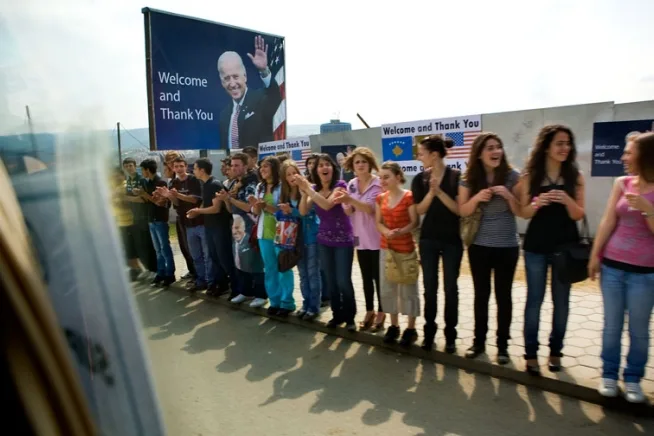
Cost of Living inPristina, Kosovo
Image credit: David Lienemann
Purchasing Power vs. United States
Based on GDP per capita (PPP). Kosovo: $15,716/capita.
How Far Your Money Goes
Prices are 71% lower than the global benchmark (New York City = 100).
Income Category
GDP per Capita
City Population
Monthly Costs
Rent
Food
Transport
Utilities
Education
Child Education
Public-school quality + expat access, alongside international and private school cost — the two paths a relocating family weighs.
Public schools
Public-schooling rules are set nationally for Kosovo; Pristina-specific enrollment notes are still being verified.
Quality
Mixed public-school option
Expat access
Possible, but language-heavy
hardInstruction
Albanian / Serbian
Language fit is more manageable.
PISA / outcomes
Qualitative only
Using curated quality notes for now.
Why this quality rating
Kosovo's public schools can work for locally integrated families, but they are not the obvious default for most expat households.
Why the expat-access rating looks like this
Resident enrollment may be possible, but Albanian- or Serbian-medium instruction makes the public route harder for most expat families.
❓ Homeschooling
Not specifically addressedKosovo requires compulsory education but does not have specific homeschooling legislation. The education system is still developing post-independence. Not a well-established path for homeschoolers.
Homeschool legality in Kosovo — check current regulations before committing.
Source: User-curated family relocation research (initial seed) (2026-04-14)
International & private schools
Childcare & Domestic Help
Current nanny and household-help pricing snapshot for Pristina, Kosovo.
Full-time nanny (5 days)
$525-$725
monthly · confidence 0.65
Live-in / 24-7 nanny
$975-$1,325
monthly · confidence 0.65
Source: curated family relocation research
Getting Around
The concrete mobility picture for Pristina: airport access, urban transit, and rideshare practicality.
Airport
International airport
Pristina has practical European coverage through the country’s main airport, though the route map is narrower than larger Balkan capitals.
Urban transit
Bus-first urban transit
Daily mobility is mostly road-based and bus-led, so central living works better than transit-heavy cross-city routines.
Rideshare
Taxi-first, limited app coverage
Taxis remain the main fallback, with app-booking options useful but not the core of the city’s mobility stack.
Source: User-curated family relocation research (initial seed) (2026-04-14)
Healthcare
System strength, outcome signals, facility coverage, and self-pay visibility in Kosovo.
Method: country metrics come from public system indicators, facility coverage reflects mapped providers we can inventory, direct pricing only reflects observed self-pay pages, and relative care cost can fall back to broad cost-of-living healthcare indices. Sparse pricing does not imply sparse healthcare availability.
Healthcare system
LimitedLow out-of-pocket burden help, but coverage looks thinner and doctor staffing is lighter.
Public care
LimitedRelatively low patient cost-sharing help, but public coverage looks thinner and public funding looks lighter.
Private care
GoodA meaningful tracked hospital and clinic network and a clearly private facility base help, but self-pay pricing transparency is still sparse.
UHC coverage
0/100
2025
Physicians
0.00/1k
2025
Hospital beds
0.00/1k
2025
Out of pocket
0%
2025
Outcome signals
Life expectancy
78.2 yrs
2024
Neonatal mortality
6.6/1k
2024
International patient readiness
MixedA visible private hospital base and multiple facilities have websites help, but price transparency is still sparse.
Pricing transparency
LimitedMultiple facilities have crawlable websites help, but published self-pay prices are scarce.
Facility coverage
Self-pay pricing visibility
No verified self-pay prices are published for the tracked facilities in Kosovo yet.
This usually reflects low online price transparency rather than a lack of healthcare providers.
Notable facilities
System metrics: World Bank WDI · Updated 2026-09-01
Safety & Governance
Street Safety
Source: Numbeo where a city row is matched; otherwise World Bank WGI and country-level safety context.
Political Stability
World Bank WGI scale: -2.5 to +2.5.
Wages by Sector
| Sector | Median |
|---|---|
| Administrative & Support Services | — |
| Agriculture & Farming | — |
| Arts, Entertainment & Recreation | — |
| Construction | — |
| Education | — |
| Finance & Insurance | — |
| Healthcare & Social Work | — |
| Hospitality & Food Service | — |
| Information & Technology | — |
| Manufacturing | — |
| Mining & Quarrying | — |
| Other Services | — |
| Professional & Scientific Services | — |
| Public Administration & Defence | — |
| Real Estate | — |
| Retail & Wholesale Trade | — |
| Transport & Logistics | — |
| Utilities | — |
2024 annual wages in Pristina, Kosovo · Source: GDP-derived estimate (national)
Price Comparison vs. US
Visa Information (US passport)
Short-stay entry
US passport holders can stay up to 90 days without a visa.
Quick comparison FAQ
Structured from the deltas already shown on this page — no invented facts, no extra data sources.
How far does your money go in Pristina compared with the US?
Your money goes about 2.3x further in Pristina than in the US, based on the current PPP estimate.
Is Pristina cheaper or more expensive overall than New York City?
Pristina is cheaper overall than New York City — overall living costs are about 71% cheaper than the global benchmark (New York City) for Pristina.
How does rent in Pristina compare with New York City?
Rent in Pristina is about 92% cheaper than the global benchmark (New York City).
How expensive are groceries and restaurants in Pristina?
Groceries in Pristina are about 69% cheaper than the global benchmark (New York City), and restaurant prices are about 74% cheaper than the same benchmark.
About Pristina
Pristina is the capital of Kosovo, a young, fast-growing city in the Balkans with one of Europe's youngest median ages and a substantial diaspora-funded property and consumption economy. Costs are among the lowest in Europe, English is widely spoken by under-40s, and the city has developed a credible startup and outsourcing scene anchored by partnerships with Germany, Switzerland, and the Nordics. Practical drawbacks include severe winter air pollution from coal-fired power, infrastructure gaps outside the center, and Kosovo's contested international status, which complicates banking, visa-free travel, and some business arrangements. Albanian and Serbian are official and English is the working language in expat and tech circles. A genuinely interesting option for remote workers and early-stage founders seeking low cost and young demographics.
See the full breakdown — free
No password needed. Takes ~30 seconds.
More cities in Kosovo
Cities with a similar cost of living
Comparable to Pristina — worth a look if you're weighing alternatives.