
Bratislava International School
American
- IB Diploma average points: 35.7 points (2026) · source
Confirmed on its own website
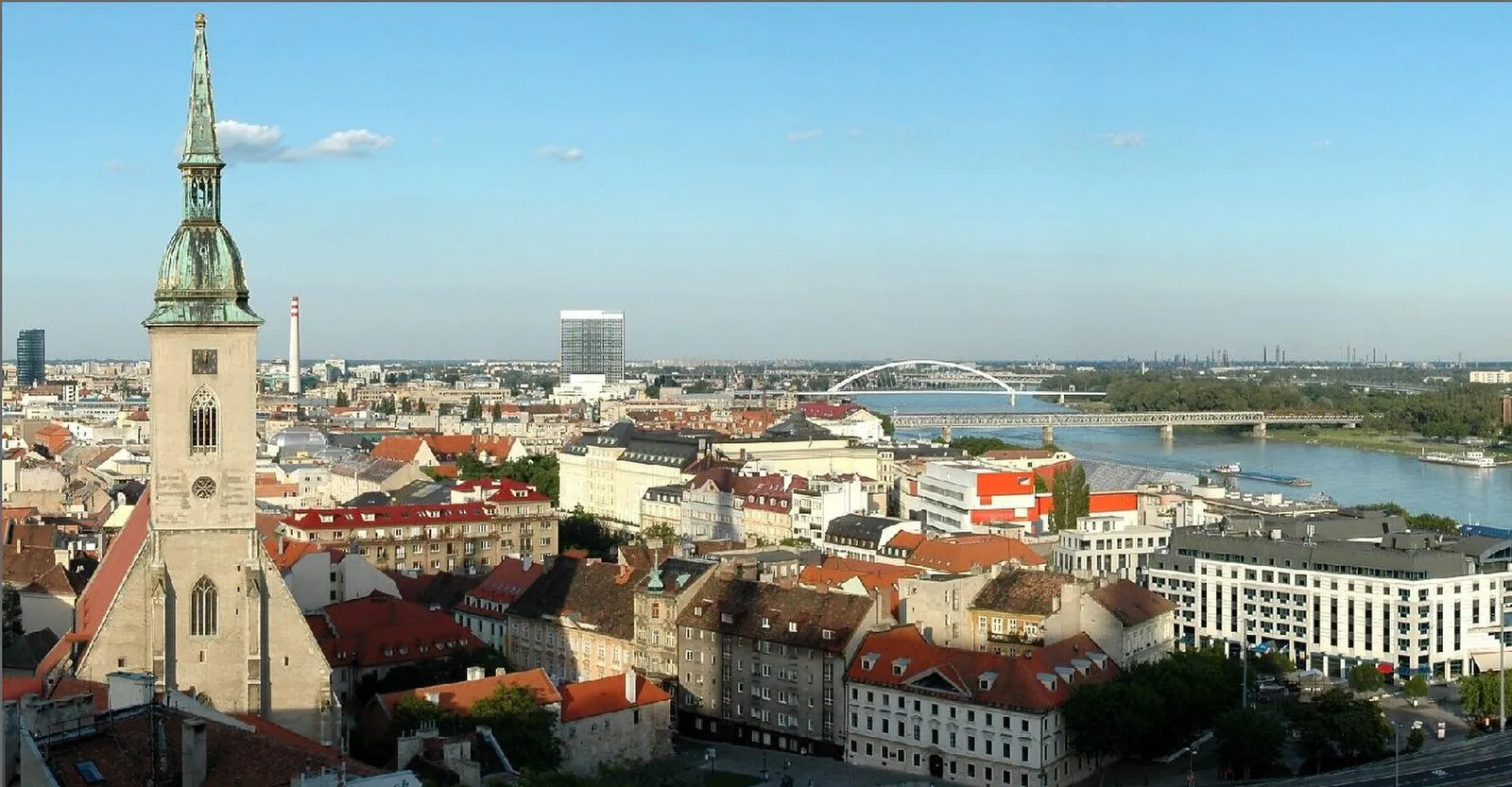
Image credit: .mw-parser-output table.commons-file-information-table,.mw-parser-output .fil...
Based on GDP per capita (PPP). Slovakia: $40,690/capita.
Prices are 45% lower than the global benchmark (New York City = 100).
Income Category
GDP per Capita
City Population
Public-school quality + expat access, alongside international and private school cost — the two paths a relocating family weighs.
This describes Slovakia as a whole. Enrollment rules and school quality can vary within the country, so check with schools in Bratislava.
Quality
Mixed quality
Assessment snapshot: 2022
Expat access
Resident families can use it
conditionalInstruction
Slovak
Local-language fluency usually matters.
PISA / outcomes
444
Well below OECD avg
PISA 2022 · OECD avg ~480
Slovakia has a functional public school system but PISA outcomes are below OECD average and have been declining. Slovak-medium instruction is the default.
Resident expat families can enroll children in Slovak public schools, though language is a significant barrier. International school options exist mainly in Bratislava.
Slovakia allows homeschooling for primary education. Students must be enrolled at a school and take biannual exams there. The school headmaster must approve the arrangement. More restrictive for secondary education.
Homeschool legality in Slovakia — check current regulations before committing.
Source: User-curated family relocation research (initial seed) (2026-04-14)
1 confirmed school
2 more suggested by AI, not verified
Confirmed on its own website
Schools' websites are found with Wikidata and OpenStreetMap (© OpenStreetMap contributors), and each is checked on the school's own site.
How schools rank by exam results →Current nanny and household-help pricing snapshot for Bratislava, Slovakia.
Full-time nanny (5 days)
$800-$1,100
monthly · confidence 0.65
Live-in / 24-7 nanny
$1,450-$1,950
monthly · confidence 0.65
Source: curated family relocation research
The concrete mobility picture for Bratislava: airport access, urban transit, and rideshare practicality.
Walkability score: 80/100 (transit supported). This is derived from the verified mobility profile and is used by the walkability gate.
Walkability
80/100
mobility profile transit backbone
Airport
International airport
Bratislava Airport gives the capital practical European air coverage, with Vienna adding a larger secondary gateway nearby.
Urban transit
Tram, regional rail, and bus
Bratislava’s trams, buses, and rail links make many central neighborhoods workable without a car even if the network is smaller than Vienna or Prague.
Rideshare
Bolt and app rides available
App-hailed rides are a routine fallback for airport trips and lower-frequency cross-city travel.
Source: User-curated family relocation research (initial seed) (2026-04-14)
System strength, outcome signals, facility coverage, and self-pay visibility in Slovakia.
Method: country metrics come from public system indicators, facility coverage reflects mapped providers we can inventory, direct pricing only reflects observed self-pay pages, and relative care cost can fall back to broad cost-of-living healthcare indices. Sparse pricing does not imply sparse healthcare availability.
Good national coverage, strong doctor availability, and solid hospital-bed capacity support this rating.
Strong public funding and country-level outcomes are comparatively strong help, but the tracked facility mix leans away from public providers.
A clearly private facility base help, but self-pay pricing transparency is still sparse.
UHC coverage
78/100
2023
Physicians
3.70/1k
2022
Hospital beds
5.57/1k
2023
Out of pocket
20%
2023
Life expectancy
78.4 yrs
2024
Maternal mortality
4/100k
2023
Neonatal mortality
3.3/1k
2024
A visible private hospital base and multiple facilities have websites help, but price transparency is still sparse.
Multiple facilities have crawlable websites help, but published self-pay prices are scarce.
No verified self-pay prices are published for the tracked facilities in Slovakia yet.
This usually reflects low online price transparency rather than a lack of healthcare providers.
System metrics: World Bank WDI · Updated 2026-11-01
Source: Numbeo where a city row is matched; otherwise World Bank WGI and country-level safety context.
World Bank WGI scale: -2.5 to +2.5.
| Sector | Median |
|---|---|
| Administrative & Support Services | — |
| Agriculture & Farming | — |
| Arts, Entertainment & Recreation | — |
| Construction | — |
| Education | — |
| Finance & Insurance | — |
| Healthcare & Social Work | — |
| Hospitality & Food Service | — |
| Information & Technology | — |
| Manufacturing | — |
| Mining & Quarrying | — |
| Other Services | — |
| Professional & Scientific Services | — |
| Public Administration & Defence | — |
| Real Estate | — |
| Retail & Wholesale Trade | — |
| Transport & Logistics | — |
| Utilities | — |
2024 annual wages in Bratislava, Slovakia · Source: SUSR (region-adjusted)
Short-stay entry
US passport holders can stay up to 90 days without a visa.
Structured from the deltas already shown on this page — no invented facts, no extra data sources.
Your money goes about 1.7x further in Bratislava than in the US, based on the current PPP estimate.
Bratislava is cheaper overall than New York City — overall living costs are about 45% cheaper than the global benchmark (New York City) for Bratislava.
Rent in Bratislava is about 78% cheaper than the global benchmark (New York City).
Groceries in Bratislava are about 47% cheaper than the global benchmark (New York City), and restaurant prices are about 47% cheaper than the same benchmark.
Bratislava is the capital of Slovakia, sitting on the Danube River at the country's western tip, within roughly an hour's drive of both Vienna and the Hungarian border. With around 424,000 residents, it is unusually compact for a national capital, with the economy concentrated in automotive manufacturing across the wider region, financial services, IT, and EU institutional functions. Relocators should weigh strong cross-border integration with Vienna including direct rail and bus links, EU and Schengen membership that simplifies movement, a moderately continental climate with cold winters and warm summers, and substantially lower costs than Vienna, against a smaller cultural footprint than Prague or Budapest, limited direct intercontinental flight access through Bratislava Airport, and a Slovak-language environment with strong English in professional sectors.
No password needed. Takes ~30 seconds.
Comparable to Bratislava — worth a look if you're weighing alternatives.