
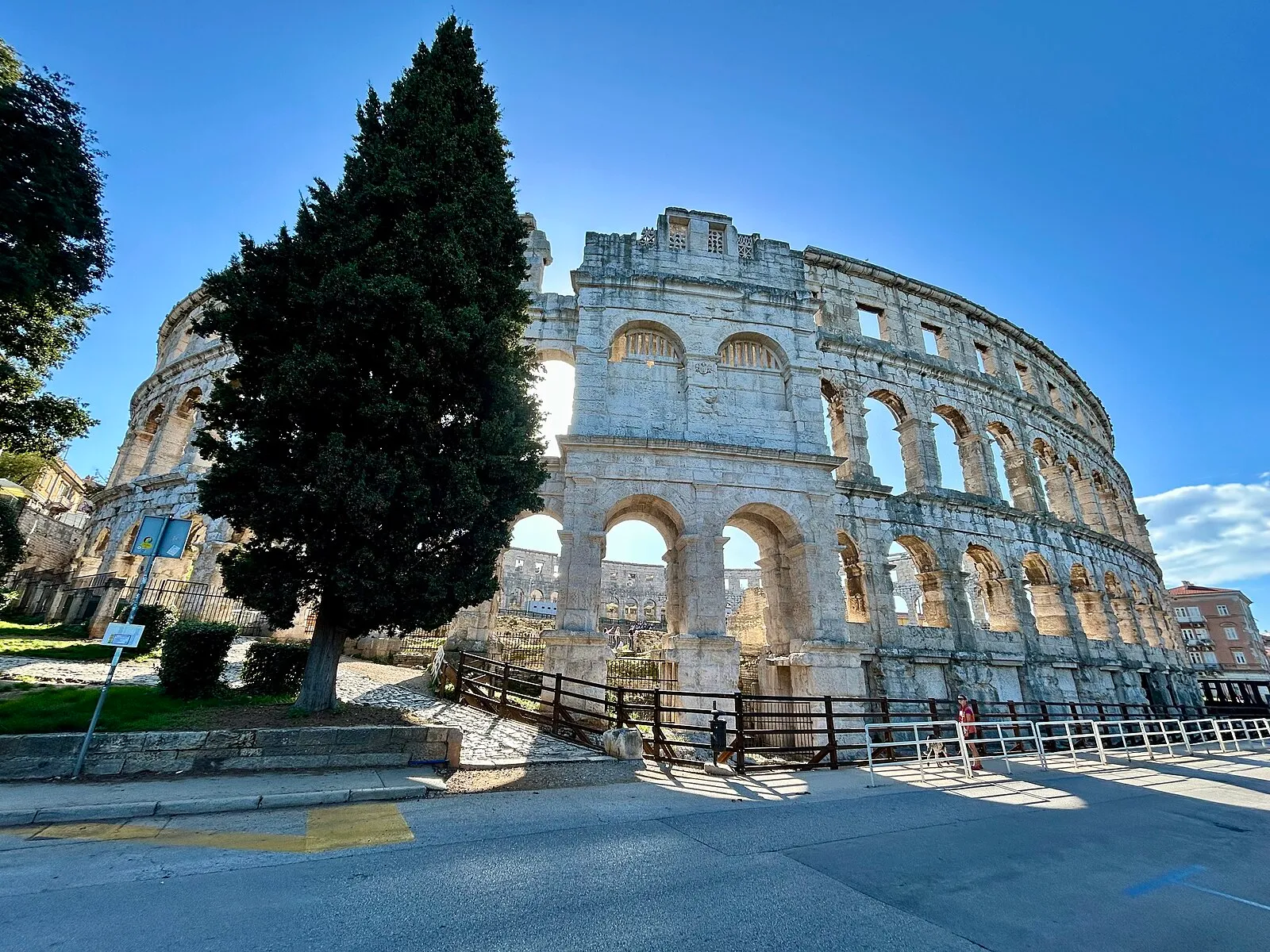
Cost of Living inPula, Croatia
Image credit: Le Monde en Vidéo
Purchasing Power vs. United States
Based on GDP per capita (PPP). Croatia: $42,829/capita.
How Far Your Money Goes
Prices are 49% lower than the global benchmark (New York City = 100).
Using the country-level NYC comparison for now. We do not have a defensible city-level aggregate cost index for this city yet.
Income Category
Happiness
5.9 / 10
#62 globally
GDP per Capita
City Population
Child Education
Public-school quality + expat access, alongside international and private school cost — the two paths a relocating family weighs.
Public schools
Public-schooling rules are set nationally for Croatia; Pula-specific enrollment notes are still being verified.
Quality
Good public schools
Assessment snapshot: 2022
Expat access
Possible, but local-language heavy
hardInstruction
Croatian
Language fit is more manageable.
PISA / outcomes
475
Near OECD avg
PISA 2022 · OECD avg ~480
Why this quality rating
Croatia’s public system is broadly solid for families prepared to plug into the local language environment.
Why the expat-access rating looks like this
Resident families can generally enroll, but Croatian is the classroom language and expat-facing support is limited.
❓ Homeschooling
Not explicitly regulatedCroatia does not have clear homeschooling legislation. School attendance is compulsory. Some families homeschool under medical or special-circumstances exemptions. Not a well-established path.
Homeschool legality in Croatia — check current regulations before committing.
Source: User-curated family relocation research (initial seed) (2026-04-14)
International & private schools
Childcare & Domestic Help
Current nanny and household-help pricing snapshot for Pula, Croatia.
Full-time nanny (5 days)
$725-$925
monthly · confidence 0.65
Live-in / 24-7 nanny
$1,400-$1,700
monthly · confidence 0.65
Source: curated family relocation research
Getting Around
The concrete mobility picture for Pula: airport access, urban transit, and rideshare practicality.
Airport
Regional airport
Pula airport plus the wider Istria coach network keep the city workable for seasonal Europe family travel, with many longer itineraries still connecting through larger Croatian or Italian hubs.
Urban transit
Bus-led urban mobility
The historic core is compact and walkable, but practical family movement across Istria is still mostly bus-, taxi-, and car-led rather than rail-based.
Rideshare
Taxi-first, some app coverage
Taxis and app-booked rides are the practical fallback for airport runs and peninsula trips where buses are indirect.
Source: User-curated family relocation research (initial seed) (2026-04-14)
Healthcare
System strength, outcome signals, facility coverage, and self-pay visibility in Croatia.
Method: country metrics come from public system indicators, facility coverage reflects mapped providers we can inventory, direct pricing only reflects observed self-pay pages, and relative care cost can fall back to broad cost-of-living healthcare indices. Sparse pricing does not imply sparse healthcare availability.
Healthcare system
StrongGood national coverage, strong doctor availability, and solid hospital-bed capacity support this rating.
Public care
StrongStrong public funding, relatively low patient cost-sharing, and country-level outcomes are comparatively strong support this rating.
Private care
LimitedThe tracked private-style network still looks thin, the private footprint is not very visible yet, and self-pay pricing transparency is still sparse weigh on this rating.
UHC coverage
76/100
2023
Physicians
3.91/1k
2022
Hospital beds
5.60/1k
2023
Out of pocket
9%
2023
Outcome signals
Life expectancy
78.9 yrs
2024
Maternal mortality
3/100k
2023
Neonatal mortality
2.8/1k
2024
International patient readiness
LimitedMultiple facilities have websites and country-level outcomes are comparatively strong help, but the private footprint is still thin and price transparency is still sparse.
Pricing transparency
LimitedMultiple facilities have crawlable websites help, but published self-pay prices are scarce.
Facility coverage
Self-pay pricing visibility
No verified self-pay prices are published for the tracked facilities in Croatia yet.
This usually reflects low online price transparency rather than a lack of healthcare providers.
Notable facilities
System metrics: World Bank WDI · Updated 2026-09-01
Safety & Governance
Street Safety
Source: Numbeo where a city row is matched; otherwise World Bank WGI and country-level safety context.
Political Stability
World Bank WGI scale: -2.5 to +2.5.
Wages by Sector
| Sector | Median |
|---|---|
| Agriculture & Farming | — |
| Construction | — |
| Finance & Insurance | — |
| Healthcare & Social Work | — |
| Information & Technology | — |
| Manufacturing | — |
| Professional & Scientific Services | — |
| Real Estate | — |
2024 annual wages in Pula, Croatia · Source: Eurostat Regional
Price Comparison vs. US
Visa Information (US passport)
Short-stay entry
US passport holders can stay up to 90 days without a visa.
Long-Term Visa Programs
digital nomad
Digital Nomad Permit
Migrated from legacy digital_nomad_visas row 3
Quick comparison FAQ
Structured from the deltas already shown on this page — no invented facts, no extra data sources.
How far does your money go in Pula compared with the US?
Your money goes about 2.0x further in Pula than in the US, based on the current PPP estimate. We are using the country-level cost index for Croatia here because a defensible city-level aggregate index is not available yet.
Is Pula cheaper or more expensive overall than New York City?
Pula is cheaper overall than New York City — overall living costs are about 49% cheaper than the global benchmark (New York City) for Pula. We are using the country-level cost index for Croatia here because a defensible city-level aggregate index is not available yet.
How does rent in Pula compare with New York City?
Rent in Pula is about 84% cheaper than the global benchmark (New York City). We are using the country-level cost index for Croatia here because a defensible city-level aggregate index is not available yet.
How expensive are groceries and restaurants in Pula?
Groceries in Pula are about 50% cheaper than the global benchmark (New York City), and restaurant prices are about 47% cheaper than the same benchmark. We are using the country-level cost index for Croatia here because a defensible city-level aggregate index is not available yet.
About Pula
Pula is a city of about 52,000 on the southern tip of the Istrian peninsula in Croatia, distinguished by a preserved Roman amphitheater that remains one of the largest intact arenas anywhere in the former Roman world. The local economy combines tourism, port and shipbuilding activity, services, and a long-running connection to the Italian-Slovenian-Croatian Istrian region. Croatian is essential, with Italian co-official locally, and English widely functional in tourism and growing in business. Pula Airport offers regional and seasonal European flights. The climate is Mediterranean with hot dry summers and mild wet winters. The city sits within a few hours of Trieste, Venice, and Ljubljana, providing strong cross-border access. Pula suits relocators wanting Istrian coastal living with proper urban services beyond the smaller resort towns nearby.
See the full breakdown — free
No password needed. Takes ~30 seconds.
More cities in Croatia
Cities with a similar cost of living
Comparable to Pula — worth a look if you're weighing alternatives.