
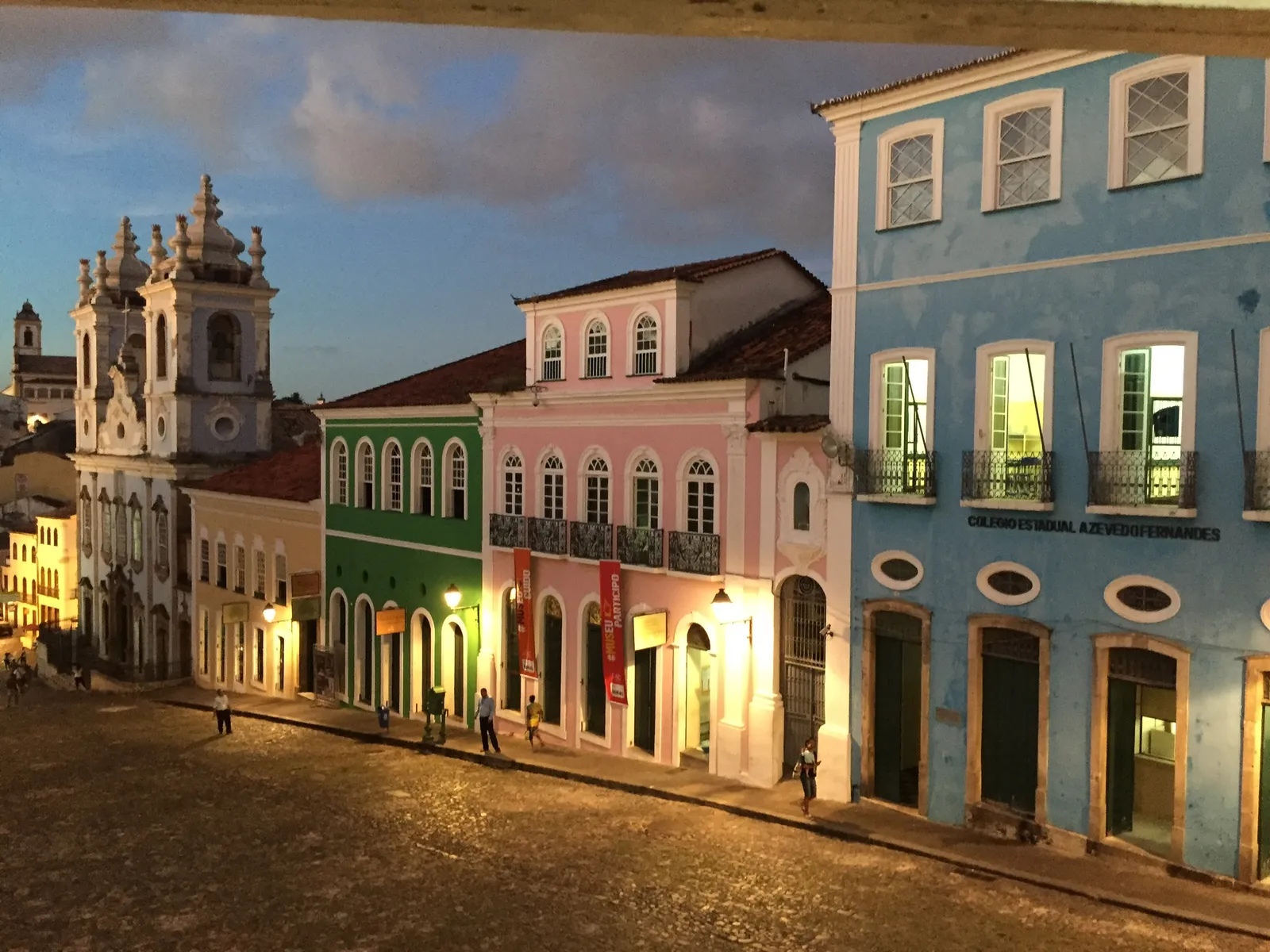
Cost of Living inSalvador, Brazil
Image credit: TMorata
Purchasing Power vs. United States
Based on GDP per capita (PPP). Brazil: $19,652/capita.
How Far Your Money Goes
Prices are 67% lower than the global benchmark (New York City = 100).
Income Category
Happiness
6.3 / 10
#43 globally
GDP per Capita
City Population
Monthly Costs
Rent
Food
Transport
Utilities
Education
Child Education
Public-school quality, expat access, instruction language, and homeschool legality for relocating families.
Public schools
Public-schooling rules are set nationally for Brazil; Salvador-specific enrollment notes are still being verified.
Quality
Mixed public-school option
Expat access
Available to residents
conditionalInstruction
Portuguese
Language fit is more manageable.
PISA / outcomes
Qualitative only
Using curated quality notes for now.
Why this quality rating
Brazil has usable public-school options, but outcomes and day-to-day quality vary sharply by state, city, and neighborhood.
Why the expat-access rating looks like this
Resident foreign families can usually enroll, but Portuguese-medium instruction and uneven school quality make the public path situational.
📋 Homeschooling
Recently legalized (2024)Brazil legalized homeschooling in 2024 after years of legal ambiguity. Families must register with the education system and students take annual assessments. Previously operated in a gray area where many families homeschooled despite uncertain legal status.
Homeschool legality in Brazil — check current regulations before committing.
Source: User-curated family relocation research (initial seed) (2026-04-14)
Childcare & Domestic Help
Estimate-only country fallback for the family-support costs we track in Brazil.
Full-time nanny (5 days)
$700-$1,050
Estimate-only country fallback
Live-in / 24-7 nanny
$1,300-$1,950
Estimate-only country fallback
Source: curated family relocation research(derived country fallback)
Getting Around
Neighborhood mobility profiles are rolling out city by city.Salvador is still missing a verified walkability, transit, airport, and rideshare profile.
Healthcare
System strength, outcome signals, facility coverage, and self-pay visibility in Brazil.
Method: country metrics come from public system indicators, facility coverage reflects mapped providers we can inventory, direct pricing only reflects observed self-pay pages, and relative care cost can fall back to broad cost-of-living healthcare indices. Sparse pricing does not imply sparse healthcare availability.
Healthcare system
GoodGood national coverage support this rating.
Public care
MixedBroad public coverage and a visible public hospital footprint help, but public funding looks lighter.
Private care
GoodA large tracked hospital and clinic network and visible specialty depth help, but self-pay pricing transparency is still sparse.
UHC coverage
84/100
2023
Physicians
2.36/1k
2023
Hospital beds
2.52/1k
2021
Out of pocket
26%
2023
Outcome signals
Life expectancy
76.0 yrs
2024
Maternal mortality
67/100k
2023
Neonatal mortality
7.1/1k
2024
International patient readiness
MixedMultiple facilities have websites and there is visible specialty depth help, but price transparency is still sparse.
Pricing transparency
LimitedMultiple facilities have crawlable websites help, but published self-pay prices are scarce.
Facility coverage
Self-pay pricing visibility
No verified self-pay prices are published for the tracked facilities in Brazil yet.
This usually reflects low online price transparency rather than a lack of healthcare providers.
Notable facilities
System metrics: World Bank WDI · Updated 2026-09-01
Safety & Governance
Street Safety
Source: Numbeo where a city row is matched; otherwise World Bank WGI and country-level safety context.
Political Stability
World Bank WGI scale: -2.5 to +2.5.
Wages by Sector
| Sector | Median |
|---|---|
| Administrative & Support Services | — |
| Agriculture & Farming | — |
| Arts, Entertainment & Recreation | — |
| Construction | — |
| Education | — |
| Finance & Insurance | — |
| Healthcare & Social Work | — |
| Hospitality & Food Service | — |
| Information & Technology | — |
| Manufacturing | — |
| Mining & Quarrying | — |
| Other Services | — |
| Professional & Scientific Services | — |
| Public Administration & Defence | — |
| Real Estate | — |
| Retail & Wholesale Trade | — |
| Transport & Logistics | — |
| Utilities | — |
2025 annual wages in Salvador, Brazil · Source: IBGE PNAD (state-adjusted)
Price Comparison vs. US
Visa Information (US passport)
Short-stay entry
US passport holders can stay up to 90 days without a visa.
Long-Term Visa Programs
digital nomad
Digital Nomad Visa (VITEM XIV)
Migrated from legacy digital_nomad_visas row 19
retirement
VIPER Retirement Visa Brazil
Quick comparison FAQ
Structured from the deltas already shown on this page — no invented facts, no extra data sources.
How far does your money go in Salvador compared with the US?
Your money goes about 2.4x further in Salvador than in the US, based on the current PPP estimate.
Is Salvador cheaper or more expensive overall than New York City?
Salvador is cheaper overall than New York City — overall living costs are about 67% cheaper than the global benchmark (New York City) for Salvador.
How does rent in Salvador compare with New York City?
Rent in Salvador is about 90% cheaper than the global benchmark (New York City).
How expensive are groceries and restaurants in Salvador?
Groceries in Salvador are about 69% cheaper than the global benchmark (New York City), and restaurant prices are about 68% cheaper than the same benchmark.
About Salvador
Salvador is the capital of Bahia state in northeastern Brazil and was the country's first colonial capital from 1549 to 1763. The economy combines petrochemicals at the Camaçari industrial pole, port logistics, tourism around the Pelourinho historic center, and a strong cultural-industries presence around Afro-Brazilian music and food traditions. Relocators considering Salvador typically weigh significantly lower rents than Rio or São Paulo, year-round tropical climate with hot humid summers and warm winters, and direct ocean access, against a security environment that is genuinely more demanding than southeastern Brazil and requires active planning by neighborhood. Portuguese is essential; English is concentrated in specific tourism zones. Barra, Pituba, and Itaigara are common expatriate residential neighborhoods. The Linha 1 and 2 metro covers limited central corridors.
See the full breakdown — free
No password needed. Takes ~30 seconds.
More cities in Brazil
Cities with a similar cost of living
Comparable to Salvador — worth a look if you're weighing alternatives.